Recommended and discouraged exercises for lumbar stenosis
Well-planned exercise improves walking tolerance and quality of life in lumbar stenosis. But not every exercise is suitable: some open the canal and bring relief, while others close it and make the symptoms worse.
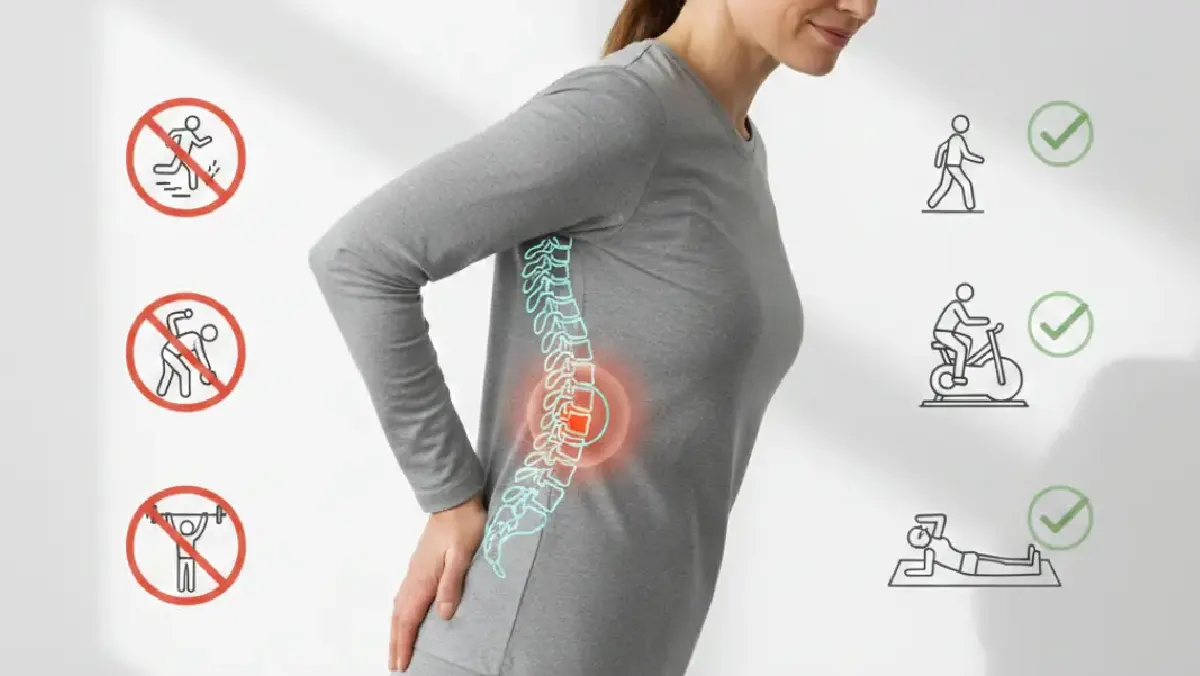
In lumbar stenosis, the exercises that open the canal and bring relief are those that take the spine into flexion: exercise bike, walking leaning slightly forward, flexion stretches, swimming and gentle work of the abdominal and pelvic floor muscles. The exercises to avoid are those that force extension (arching the back), because they close the canal and increase the compression: lumbar hyperextensions, standing overhead loads or running on hard surfaces. The practical rule is simple: if a posture brings on the pain and heaviness in the legs, that movement is not suitable. Well-planned exercise improves walking tolerance, but it does not widen the canal. When the limitation is significant despite following the programme, it is time to consider surgery.
Why flexion relieves and extension hurts
The lumbar canal gains space when the spine bends forward and loses it when it extends backwards. That is why patients with stenosis feel better sitting, leaning on a shopping trolley or cycling, and worse standing upright. The whole exercise programme is built on this principle. You can read more in Lumbar stenosis: what it is and why walking is hard.
Recommended exercises
- Exercise bike: allows aerobic exercise in flexion without triggering the pain.
- Treadmill walking leaning slightly forward or with support.
- Flexion stretches (knees to chest, cat) and gentle mobility.
- Swimming, especially strokes that do not force cervical and lumbar extension.
- Gentle core work: deep abdominal and pelvic floor activation, without extreme loads.
Exercises to avoid
- Lumbar hyperextensions and face-down "superman" exercises.
- Lifting weights overhead while standing.
- Running on asphalt or hard surfaces.
- Standing fully upright for long periods.
A practical rule
If a movement brings on the heaviness, cramping or pain running down the legs, it is not right for you, regardless of whether it works for someone else. The programme is always tailored with the physiotherapist.
When exercise is no longer enough
Exercise improves symptoms and function, but it does not widen the narrowed canal. If the distance you can walk shrinks a lot despite following the programme properly, or if weakness appears in the legs, it should be reassessed: it may have become a surgical problem. See When is lumbar stenosis severe?
Related information
Frequently asked questions
Can I walk every day with lumbar stenosis?
Yes, within your tolerance. Many patients walk better leaning slightly forward or alternating with cycling.
Are sit-ups off-limits with stenosis?
Classic sit-ups done in extension or with heavy loads are best avoided. Deep, controlled core work is recommended.
Can exercise avoid the need for surgery?
In many cases it helps control symptoms and delay or avoid surgery, but not in all: it depends on the degree of narrowing and how the condition evolves.
Is exercise no longer controlling the pain?
When conservative care is no longer enough, the team assesses whether decompression surgery is advisable in your case.
Did you find this article useful?
Add us as a preferred source on Google and our articles will show up sooner in your searches.