What are the risks of DBS and how are they minimised?
Brain haemorrhage, infection and stimulation-related side effects are the three main risks of deep brain stimulation. None of them is unavoidable: each has a specific measure that reduces it, and they are worth knowing before you decide.
DBS is not a risk-free therapy. The three main risks are brain haemorrhage, infection and side effects arising from the stimulation itself, and all of them can be minimised in experienced centres through MRI-based planning, shorter operating times and targeted programming.
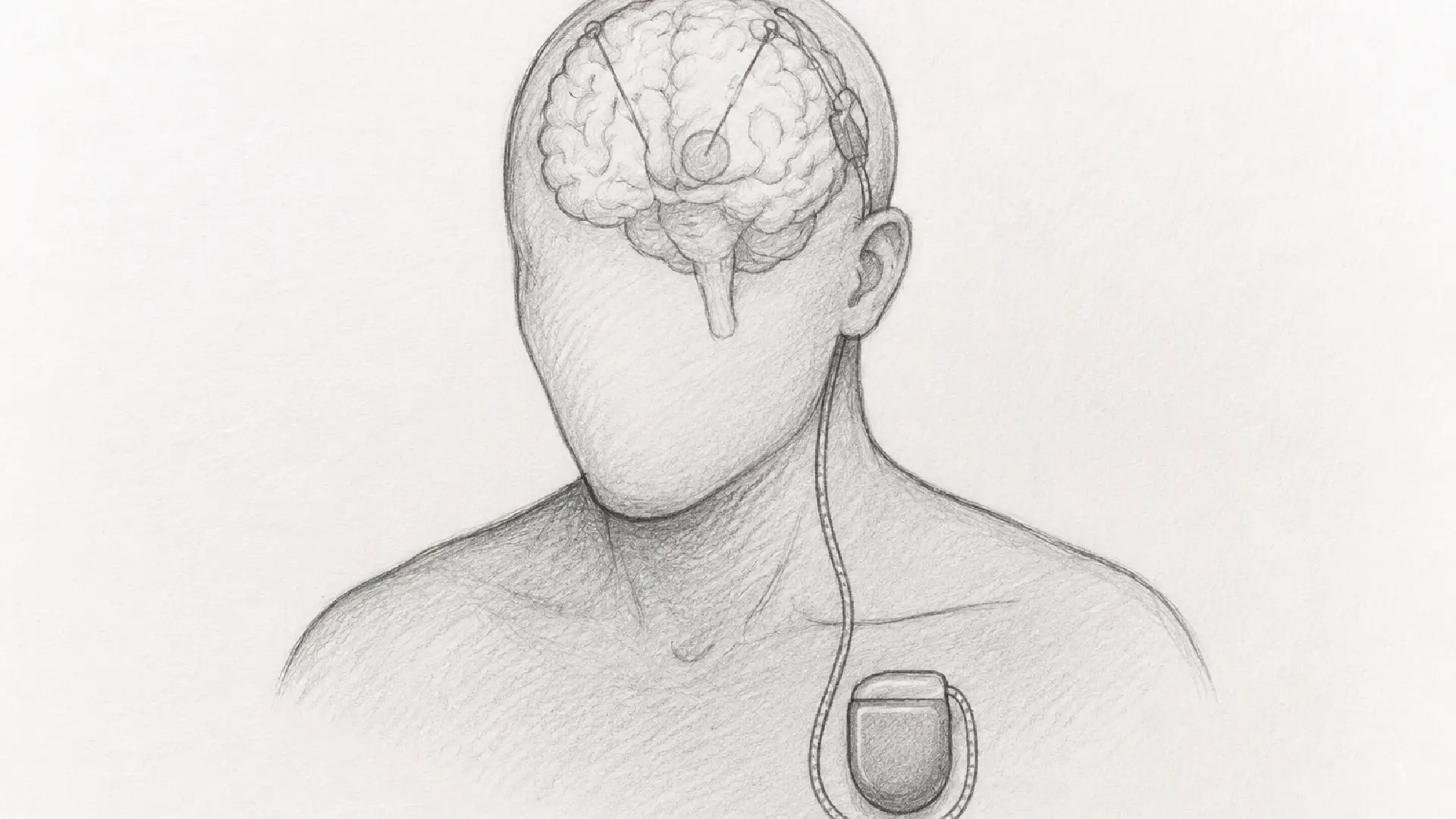
The essentials, in five lines
- Brain haemorrhage is the most feared risk and the least frequent: around 2 % to 3 % of patients, with a permanent deficit in about 1 %.
- Infection is around 2 % in recent series and is the commonest reason for having to remove hardware.
- Stimulation side effects are frequent but reversible: they are corrected by adjusting settings, not by operating again.
- The device itself also fails over the years (leads, generator), which is solved with planned minor surgery.
- None of this replaces an individual assessment: the figure that matters is the one for your case, not the average.
The four risks at a glance
It helps to separate four things that tend to be mixed in the same conversation: what can happen on the day of surgery, what can happen in the following weeks, what the current produces once the system is switched on, and what happens to the device over the years. Their frequencies and consequences are very different.
| Risk | When it appears | Indicative frequency | How it is reduced |
|---|---|---|---|
| Brain haemorrhage | During electrode implantation | Around 2 % to 3 % per patient; permanent deficit or death in about 1 % | MRI-planned trajectory avoiding vessels, blood pressure control and fewer electrode passes |
| Infection | First weeks or months after implantation | Around 2 % in recent series, up to 5 % or 6 % in broader reviews | Short operating times, antibiotic prophylaxis and careful handling of the generator pocket |
| Stimulation side effects | When the system is switched on and adjusted | Very common transiently (paraesthesia is reported in up to 79 % of patients while testing contacts) | Reversible: corrected by lowering amplitude, switching contact or turning the system off |
| Device complications | Over the years of use | Generator failure or lead fracture in roughly 6 % to 9 %; skin erosion around 2.5 % | Regular review, careful tunnelling and planned generator replacement |
Pooled figures from published meta-analyses and series (see references). They vary with the target stimulated, age, comorbidity and centre, and do not replace the individual estimate a neurosurgeon makes with your scans in front of them.
What is the risk of brain haemorrhage with DBS?
The brain contains small blood vessels that the electrode must avoid on its way in. If they are damaged, a brain haemorrhage can occur. It is the risk that worries patients most in consultation and, at the same time, the least frequent of the four: recent meta-analyses pool an incidence of around 2 % to 3 % per patient operated on, and slightly more than half of those haemorrhages cause symptoms. The figure that really matters is the one for haemorrhages leaving a permanent deficit or proving fatal, which sits at about 1 %.
Preoperative MRI makes it possible to plan, on a computer, a trajectory that avoids those vessels, which reduces the risk of haemorrhage. Alongside that planning, three other factors count:
- Number of electrode passes. Every additional track through tissue adds risk. Reducing them is one of the technical reasons for operating with the patient asleep and verifying position by imaging.
- Blood pressure control during the procedure and in the following hours.
- Drugs affecting coagulation. Anticoagulants and antiplatelet agents are stopped with the prescribed lead time; this is one of the points most worth going over with the team.
One useful clarification: DBS involves no craniotomy. Access is through a small opening in the skull (a burr hole) through which the electrode is introduced, not a bone window as in brain tumour surgery.
Is there a risk of infection in DBS surgery?
Yes. As in any procedure where a clean cavity is opened, a germ can be introduced during surgery. And there is a specific factor here: DBS leaves hardware behind (electrodes, extensions and generator), and implanted hardware is more vulnerable to infection than healthy tissue. Recent series report figures around 2 %; broader reviews, using different reporting criteria, reach 5 % or 6 %.
Shorter operating times, made possible by asleep surgery, reduce the risk of infection. To that are added antibiotic prophylaxis, careful handling of the subcutaneous pocket housing the generator, and wound surveillance during the first weeks. The published average is not a ceiling: the high-volume programme at Hospital Clínic Barcelona reports under 0.5 % infections or reoperations across more than 300 procedures (see below).
Why it matters so much: unlike other complications, a deep infection of the system usually forces removal of some or all of the hardware, treatment of the infection and reimplantation later. It is not a life-threatening risk, but it is the one most likely to delay treatment.
Why is the patient asleep during surgery?
For years DBS was performed with the patient awake, so that the clinical response to stimulation could be checked in theatre. With better intraoperative imaging and planning, asleep surgery has become established: it shortens operating times, which reduces the risk of infection, and it also allows greater precision when implanting the electrodes.
The evidence supports that decision. Meta-analyses comparing both strategies in Parkinson's disease find no significant differences in motor improvement, medication reduction or complication rates, and do describe fewer electrode passes under general anaesthesia. For the patient the practical difference is considerable: there is no need to stay still for hours, awake and with the frame in place, which matters especially in older people or those with anxiety.
The Brain & Spine team performs the procedure under general anaesthesia, with electrode position verified by intraoperative O-ARM CT without taking the patient out of theatre, and with the NEUROMATE cranial robot assisting the stereotactic implantation. The full procedure is described on the DBS for Parkinson's disease page.
What side effects can stimulation cause?
Deep brain stimulation can cause undesirable side effects. They are the most frequent of everything covered in this article and, at the same time, the least serious, because they depend on a current that can be modified. The commonest are:
- Paraesthesia (tingling). The most common effect when testing contacts during programming; it is reported in up to 79 % of patients at some point in the adjustment. It settles by lowering the amplitude or changing the stimulation configuration.
- Dysarthria (slurred or less clear speech). Common with stimulation of the thalamic region, with widely varying figures across series depending on how it is measured. It usually reverses when settings are adjusted.
- Gait and balance disturbance, more common with bilateral than unilateral stimulation.
- Changes in mood, apathy or impulsivity, less frequent, requiring joint assessment with neurology and adjustment of medication as well as stimulation.
Preoperative and postoperative programming tools reduce the appearance of these stimulation-related effects. Planning in advance makes it possible to anticipate which electrode contacts sit close to structures that produce these effects, and to avoid them from the first adjustment.
The underlying difference: a stimulation side effect is reversible because the current can be turned up, turned down, redirected to another contact or switched off. An effect caused by a thermal lesion, such as the one created by HIFU, cannot be undone. This is an argument for DBS when adjustment over time is expected to be needed.
How is DBS adjusted after surgery?
Once the electrodes are implanted and a first patient-specific programming session has been carried out, a progressive programming process begins to find the best balance between clinical benefit and possible adverse effects. It is not a single event but a path.
- First programming session. Each electrode contact is tested, the amplitude at which benefit appears and the one at which the unwanted effect appears are recorded, and the configuration with the widest window between them is chosen.
- First weeks. Adjustments concentrate here, alongside the progressive reduction of dopaminergic medication where appropriate, always coordinated with neurology.
- Stabilisation. Visits are spaced out and the system is retouched only when the clinical situation changes.
- Long-term follow-up. The disease follows its course and stimulation adapts to it; battery status is also monitored.
This continuous work between functional neurosurgery and neurology is part of deep brain stimulation therapy, not an optional extra. A well-placed implant with poor follow-up performs below its potential.
The video: the risks, explained in two minutes
The same risks, covered by Dr. Pedro Roldán Ramos, functional neurosurgeon in the Brain & Spine team. Video in Spanish.
Video chapters
- DBS is not a risk-free therapy
- What is the risk of brain haemorrhage?
- What about the risk of infection?
- Why asleep surgery is more precise
- Side effects of stimulation
- Progressive programming: clinical benefit versus adverse effects
Long-term device risks
There is a fourth category that is discussed less in the first consultation and is worth bearing in mind, because it is not rare: complications of the implanted system itself. Long series describe generator failure or lead fracture in roughly 6 % to 9 % of cases over follow-up, and skin erosion over the hardware in around 2.5 %.
- Generator replacement. Non-rechargeable batteries run out over the years and are replaced in a minor procedure. Rechargeable ones extend that interval considerably in exchange for a charging routine.
- Fracture or migration of the extension lead, which shows up as an abrupt loss of effect and is solved by repairing the affected segment.
- Skin erosion, more likely in thin patients or where the skin over the hardware is fragile.
None of these situations calls the indication into question, but they explain why DBS means a long relationship with the team that implants it rather than a single surgical event.
Does the centre where you are operated on matter?
Yes, measurably so for some indicators. Analyses of large hospital databases show that higher-volume centres have fewer wound complications, fewer prolonged stays and better discharge destinations than low-volume ones, although not every study finds the same signal across all indicators.
A concrete example of what accumulated experience means: Hospital Clínic Barcelona, a national reference centre for deep brain stimulation where several of the Brain & Spine neurosurgeons practise, has performed more than 300 DBS procedures over more than 25 years in movement disorders, with reported results showing no mortality and under 0.5 % infections or reoperations for side effects. That infection figure is below the 2 % described in international series. The data are collected in this article on the Clínic DBS programme.
The Brain & Spine team operates on more than 1,000 cases a year across the main private hospitals in Barcelona, with the same technical approach: the NEUROMATE cranial robot for implantation, intraoperative O-ARM CT to verify position, and a multidisciplinary board with neurology and neuropsychology before surgery is indicated.
Beyond the number of procedures, what changes the outcome is a set of things you can ask about at the first visit:
What to ask before deciding
- How many DBS systems does the team implant per year, and since when?
- Who will review my case? Is there a board with neurology, neuropsychology and functional neurosurgery?
- Is surgery performed awake or asleep, and why in my case?
- How is electrode position verified during the procedure?
- Who does the programming afterwards, and how often are the visits?
- What happens if a side effect appears on a Sunday? Who do I call?
- Is the surgeon who assesses me the one who will operate?
Warning signs after discharge
Most of the postoperative period passes without incident, with discharge usually at 2 to 3 days. Contact the team, without waiting for the next appointment, if you notice:
- Fever, redness, warmth or discharge from any of the wounds.
- Severe and worsening headache, vomiting or unusual drowsiness.
- Sudden loss of strength, altered speech or facial droop.
- Sudden disappearance of the benefit obtained, which may indicate a device problem.
- Striking changes in behaviour, mood or impulsivity noticed by those around you.
What if I would rather not have anything implanted?
When tremor is the dominant symptom there is an alternative with no incisions and no implanted hardware: high-intensity focused ultrasound (HIFU), which creates a thermal lesion in a single MRI-guided session. Its risk profile is different, not necessarily lower:
- There is no implant, so there is no risk of hardware infection or battery replacement.
- In exchange, the lesion is permanent: what is gained and what is lost cannot be readjusted afterwards.
- Today it is essentially a unilateral treatment, whereas DBS allows bilateral modulation.
The full comparison, with the criteria that tip the decision one way or the other, is on HIFU for Parkinson's disease and on the Neuro-HIFU hub.
Related information
Frequently asked questions
What is the risk of brain haemorrhage with DBS?
The brain contains small blood vessels that the electrode must avoid on its way in. If they are damaged, a brain haemorrhage can occur. Meta-analyses place haemorrhage at around 2 % to 3 % of patients operated on, and haemorrhage leaving a permanent deficit or proving fatal at about 1 %. Preoperative MRI makes it possible to plan a trajectory that avoids those vessels, which minimises the risk.
Is there a risk of infection in DBS surgery?
Yes. As in any procedure where a clean cavity is opened, a germ can be introduced during surgery. Recent series report figures around 2 %, and broader reviews up to 5 % or 6 %. Shorter operating times, made possible by asleep surgery, reduce that risk.
Why is the patient asleep during surgery?
Asleep surgery shortens operating times, which reduces the risk of infection, and also allows greater precision when implanting the electrodes. Meta-analyses comparing awake and asleep surgery find no difference in motor outcome or complications, and do find fewer electrode passes under general anaesthesia.
What side effects can stimulation cause?
Deep brain stimulation can cause undesirable side effects: tingling, altered speech, changes in gait or balance and, less often, changes in mood or impulsivity. Preoperative and postoperative programming tools reduce their appearance, and almost all of them reverse when the settings are adjusted.
Are stimulation side effects permanent?
Generally not. Unlike a lesioning technique, stimulation can be turned up, turned down, redirected to another electrode contact or switched off. Tingling and altered speech usually disappear when the amplitude is reduced or the configuration is changed. If an effect does not settle with reprogramming, the strategy is reconsidered together with the neurology team.
How is DBS adjusted after surgery?
Once the electrodes are implanted and a first patient-specific programming session has been carried out, a progressive programming process begins to find the best balance between clinical benefit and possible adverse effects. Adjustments concentrate in the first weeks; visits are then spaced out.
Can DBS be removed if it does not work out?
Yes. DBS does not destroy brain tissue: it modulates its activity. The system can be switched off, reprogrammed or surgically removed. That reversibility is one of the fundamental differences from ablative techniques such as HIFU.
What is awake brain surgery?
It is a technique in which the patient stays awake and cooperates during part of the operation while the cortex is stimulated, so that language or motor areas can be located in real time and preserved. It is used above all in brain tumour surgery close to eloquent areas. DBS, by contrast, is performed with the patient asleep.
What is an awake craniotomy, and is it used in DBS?
A craniotomy is the opening of a window in the skull. In the awake variant the patient is woken during the resection so they can cooperate while the cortex is mapped. DBS involves no craniotomy but a small opening (burr hole) through which the electrodes are introduced.
References consulted
- Meta-analysis of intracranial hemorrhage in deep brain stimulation: incidence, surgical approach, laterality, symptoms and center experience. Neurosurgical Review, 2026. View publication
- Comprehensive characterization of intracranial hemorrhage in deep brain stimulation: a systematic review of literature from 1987 to 2023. Journal of Neurosurgery, 2024. View publication
- Awake versus asleep deep brain stimulation for Parkinson's disease: a comprehensive systematic review and meta-analysis. Journal of Neurosurgery, 2024. View publication
- Management of essential tremor deep brain stimulation-induced side effects. Frontiers in Human Neuroscience, 2024. View publication
- Complications after deep brain stimulation: a 21-year experience in 426 patients. Frontiers in Aging Neuroscience, 2022. View publication
- Predictors of unfavorable outcomes following deep brain stimulation for movement disorders and the effect of hospital case volume on outcomes. Neurosurgical Focus, 2015. View publication
- Deuschl G. et al. A randomized trial of deep-brain stimulation for Parkinson's disease. N Engl J Med, 2006. View publication
Considering DBS and worried about the risks?
Our functional neurosurgery team reviews your case and explains, with your scans in front of them, which risks actually apply to your situation and how they are minimised.
Did you find this article useful?
Add us as a preferred source on Google and our articles will show up sooner in your searches.